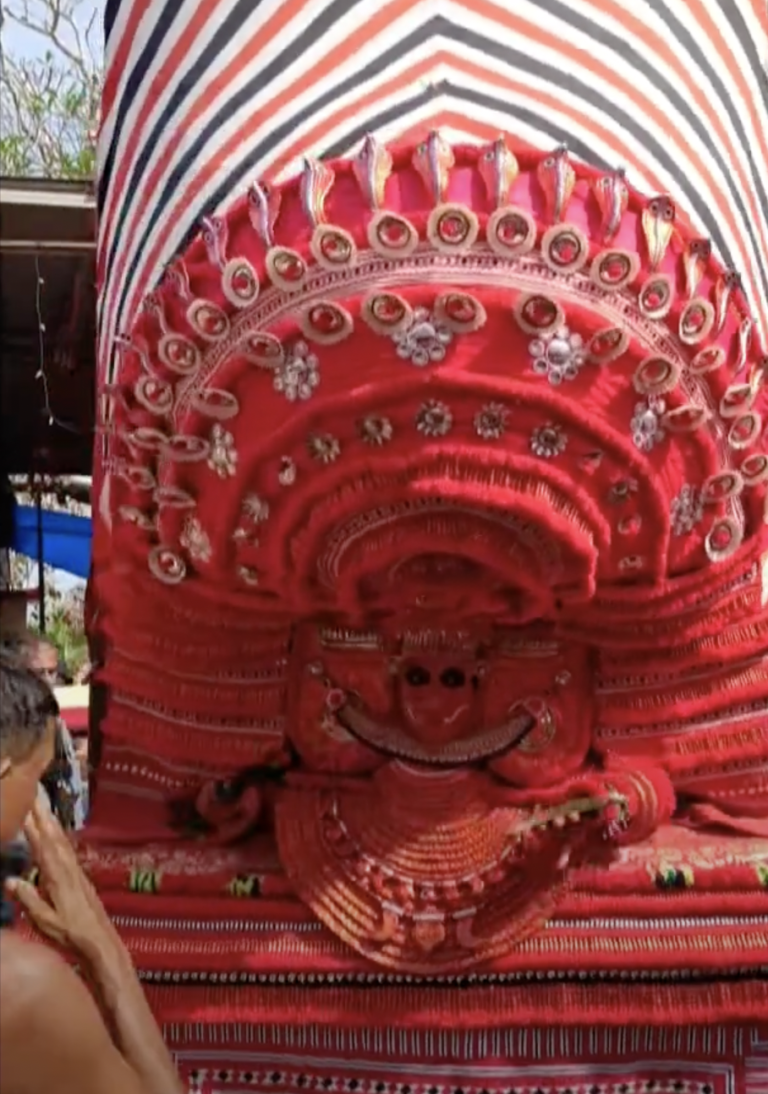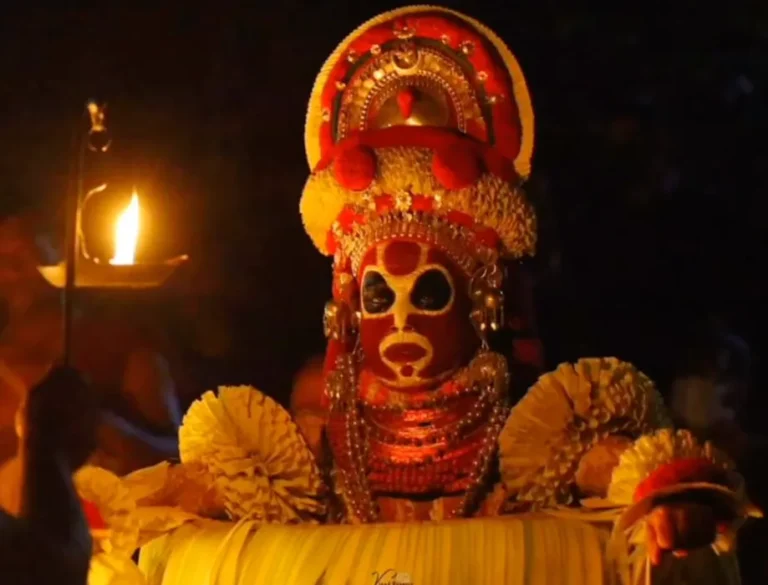
Pulichamundi Theyyam

Pulichamundi is a Theyyam that belongs to the group of Theyyams where humans become gods after death. Pulichamundi is a Theyyam that is worshipped in the Tulu nadu and in the hill villages of Kasaragod district. Pulichamundi is usually the sub-deity of the main deity in the Kavus.

The legend of Pulichamundi is as follows. Since the mother of the Tuluvangam family did not have children, she constantly performed Parvati puja. Thus, after praying for many days, the mother gave birth to four sons. Later, a baby sister was born to all four children. They named her Mathu.

They cherished and raised the only female child in the family and married her when she grew up. But even after many years, she did not have a child. The four brothers, who were saddened by this, did penance. As a result, she became pregnant, but the vaidya(Doctor) predicted that she would have an unlucky child. The four brothers, who were saddened by this, guarded her day and night.

She, who had longed to bathe after the festival, had gone to the field to comb leaves to comb her hair. At that very moment, a tiger jumped out and bit her and dragged her away. The brothers, who were distraught at not seeing their sister, searched the whole country. Suddenly, they saw the tiger biting half of her body. Unable to bear the grief and anger, they killed the tiger with an arrow. Thus, the tiger also fell dead next to the half-body of their sister.

Suddenly, in front of the four brothers, who were crying over the loss of their sister, Matu, a divine goddess, appeared in the form of a goddess. She said that Chamundi, who took the form of a tiger (Puli), has touched her, so from now on I will be known as Pulichamundi. The mother of the Tuluvangam family thus became Pulichamundi and the goddess after her death, and later in Tulu and the surrounding areas, Pulichamundi started being performed as a Theyyam. People belonging to the Cheron and Paravar castes perform this Theyyam.

Screenshot 2025-02-22 at 3.27.06 PM
previous arrow
next arrow
Screenshot 2025-02-22 at 3.27.06 PM
Screenshot 2025-02-22 at 3.31.31 PM
Screenshot 2025-02-22 at 3.29.11 PM
Screenshot 2025-02-22 at 3.20.54 PM
previous arrow
next arrow

Similar Posts

  • Chuzhali Bhagavathi Theyyam

    In ancient times, the local kings used to divide their territories by dividing their borders for administrative convenience. Such small local kingdoms are called swaroopam. The main swaroopams of North Kerala are Allada swaroopam, Kola swaroopam and Kottayam swaroopam. The old name of Kola swaroopam was Mushika Vansam. Later, for administrative convenience, Kola swaroopam was…

  • Karinjamundi

    Karinchamundi is the most fury looking Theyyam among the Theyyams in northern Kerala. Karinjamundi is mainly performed in the hilly areas of Kannur district. Karinjamundi Theyam, which is extremely brutal in appearance, demeanor and rituals, is sure to strike fear into the tender hearted. It is believed that Karinjamundi is the goddess who defeated Mahishasura,…

  • Madayil Chaamundi

    The origin of the name Chamundi is derived from the meaning of Goddess who killed the evil and powerful Asura brothers named Chandan and Mundan. Shumbha Nishumbhan, who had received the boon from Lord Brahma that only women could kill him, was destroying all the three worlds, while Chandamundan was their servant and joined in…

  • Devakkooth

    Devakkooth is the only theyam that is performed by women. Devakkooth also known as Valli Theyam. Although most of the Theyas in the Theya universe are female deities, including mother deities, naga deities, maidens, and village deities, they are all performed by men. The fact that it is the woman who weaves the devakooth among…

  • Raktha Chamundi

    Raktachamundi is a Theyyam who is the most important of the Mother Gods in the Theyyam universe. Raktachamundi is the clan god of the Moovari community. Rakta Chamundi is performed in most of the caves between Valapattanam river in the south and Kumbala in the north. Rakta Chamundi is also performed with Vishnu Murthy in…

  • Vettaykkorumakan

    This Theyam is known as Vettaikakaran, Vettakkarumakan and Vettakarumakan. However, the name Vettayakorumakan is more popular. In the Mahabharata, there is a story of Lord Shiva giving Pashupatastra, a devine weapon to Arjuna in Vanaparvam chapter. It is the background of this story that is the basis of the genesis of the legend of Vettaikkorumakan,…